
Wall Balls and Sled Push: How to Master the Toughest Stations
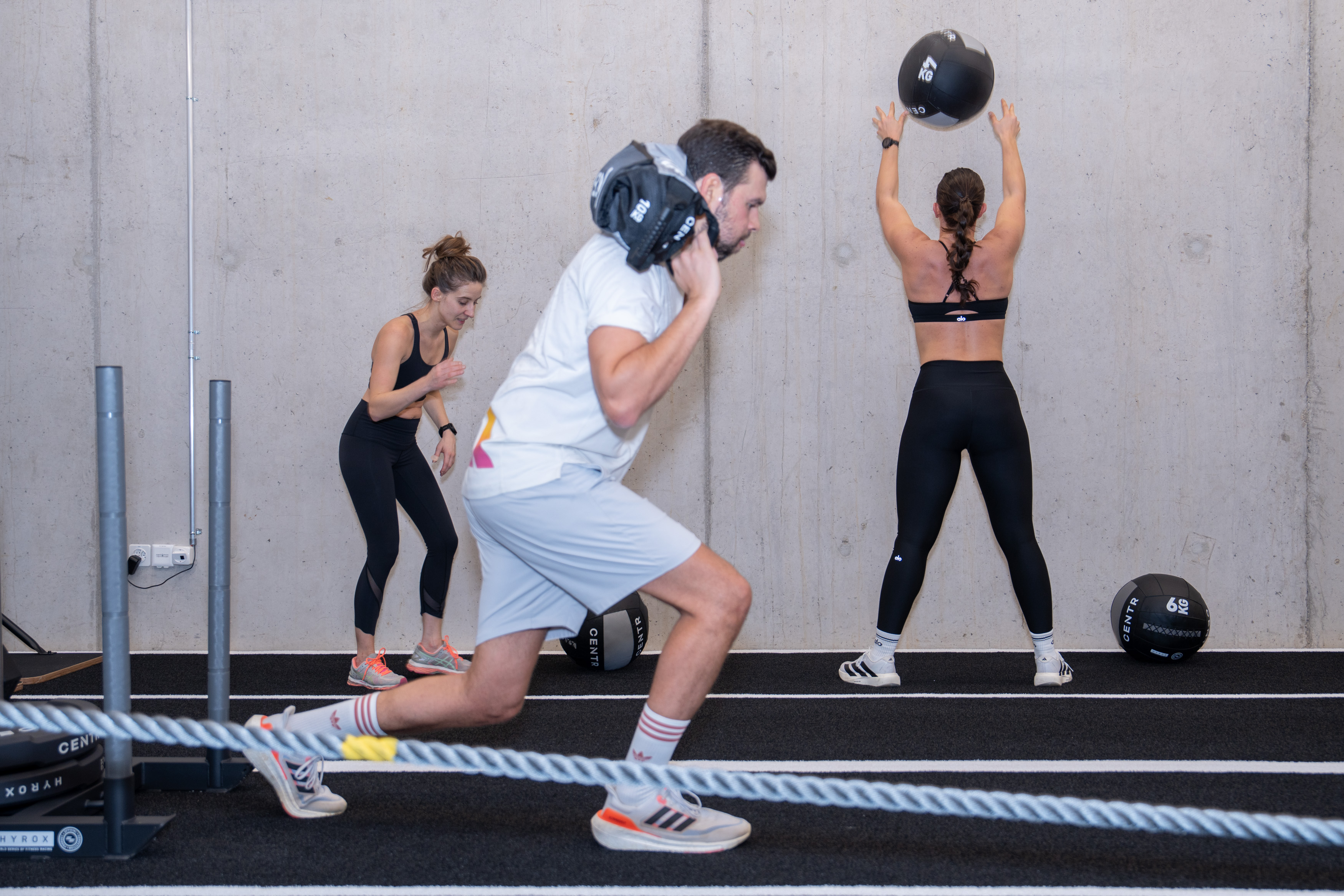
On the sled push you gain time with a flat body line and short, quick steps. On the wall balls you gain time with a fluid combination of squat and throw and with fixed, planned sets instead of reps to failure. Both stations are best trained in combination with running.
Sled push: technique
- Body position: lean into the sled at an angle of about 45 degrees. Head, back and rear leg form a line.
- Arms: either almost straight on the high handles or bent with your hands close to your body on the low handles. Test in training which gives you more power.
- Steps: short, quick and on the forefoot. Long strides slow you down and cost grip.
- Start: the first push is the hardest. Keep moving after each turn instead of setting up again.
Sled push: training
Train heavy pushes over 10 to 15 metres with full recovery for strength, and lighter ones over 25 to 50 metres for endurance. Add leg strength such as squats, Bulgarian split squats and calf raises. Once a week, a combination such as 1 km run, 25 m sled push, 1 km run helps you practise running on tired legs.
Wall balls: technique
- Catch and drop: catch the ball at chest height and take it straight into the squat.
- Drive up: stand up explosively from the bottom position and transfer the power of your legs into the throw. The arms only finish the movement.
- Breathing: breathe in on the way down, breathe out on the throw.
- Target: throw slightly above the target line. Every no-rep costs time and energy.
Wall balls: set strategy
At the end of the race your legs are heavy. Throwing to failure means long breaks afterwards. Planned sets with short, fixed breaks work better, for example 10 × 10, or 20, 15, 15 at the start followed by sets of 10. Train exactly this strategy so it runs automatically on race day. Training exercises: wall ball intervals after lunges or after a fast kilometre, front squats and light thrusters.
Common complaints
The sled push often strains calves and Achilles tendons, wall balls knees and shoulders. Increase the load gradually and have persistent pain assessed. More in HYROX Training Without Injuries. At Kineo, sports physiotherapy is in the same building.
Frequently asked questions
How many wall balls should I do in training?
Once or twice a week, 50 to 100 reps in sets is enough for most people. Quality under fatigue matters more than volume.
Can I train the sled push without a sled?
Partly, for example with heavy lunges or hill sprints. You only learn the specific technique on the sled, though.
Am I allowed to take breaks on the sled push?
Yes. Short, planned breaks are better than a complete collapse in the second half.
Training at Escher-Wyss-Platz
At Kineo you train the sled push and wall balls with coaching in our HYROX group classes. To get started, try 3 sessions for CHF 65. An overview of all eight stations is in The 8 HYROX Stations.
Bereit für dein erstes HYROX-Training?
Train at Escher-Wyss-Platz in Zurich: 3 sessions for CHF 65.
Training buchen